Map subscriptions
Map subscriptions is an experimental feature available since Centrifugo v6.8.0. All its parts — configuration options, client SDK API, server API — may change in future releases based on user feedback. At this point only centrifuge-js SDK supports map subscriptions on the client side.
A map subscription delivers a real-time key-value collection whose lifecycle is managed by Centrifugo. The map broker stores the entries, tracks per-key updates, and synchronizes them to every subscribed client — clients receive a complete snapshot on subscribe, catch up after disconnects, and get live updates in real time. The application doesn't need to maintain its own snapshot table, write a separate "fetch initial state" endpoint, or reconcile race conditions between an HTTP read and a WebSocket stream. That's the whole point: Centrifugo owns the collection, the SDK keeps a live mirror.
Typical use cases — workloads where Centrifugo is the natural store for the data:
- Cursor positions, typing indicators — short-lived per-client entries, no need for an external DB.
- Map presence —
map_clients(one entry per connection) andmap_users(one entry per user) are server-managed presence built on this same sync model. - Lobby members, IoT device fleet, feature flags, live polls — collections that are naturally key-shaped, where having Centrifugo hold the canonical entries (with per-key TTL, optional persistence) avoids building a separate small-store + change-feed yourself.
- Scoreboards, inventories — persistent keyed state with efficient reconnect recovery.
When to use map subscriptions — and when not to
Map subscriptions are the natural fit when the broker should be the canonical store for a keyed collection — your application is comfortable letting Centrifugo own the entries and reads them back through subscriptions (or, for backends that need it, the server map_read_state API).
When your data already lives in your own application database (orders, documents, tickets, notifications), there's an alternative shape worth knowing about: a stream subscription with a getState callback, backed by the PostgreSQL stream broker. You write to your own tables and call cf_stream_publish in the same SQL transaction — clients render state from your own schema and receive events for incremental changes, with no duplicate state in the broker. See Transactional publishing for stream subscriptions with PostgreSQL and the pg_stream_broker example.
That said, map subscriptions can still be the right answer even when the data has a home elsewhere — if the convenience matters more to you than the duplication. With map subscriptions you get the synchronized snapshot, paginated state delivery, and per-key TTL with auto-removal out of the box. With stream + getState you have to build the snapshot endpoint yourself and reason about what your subscription consumer rebuilds on the client. Neither is universally better — pick by what you'd rather own.
| You need… | Natural fit |
|---|---|
| Ordered events (chat, notifications, activity feeds) | Stream subscription |
| Latest value of a single thing (with cache recovery) | Stream subscription + cache recovery |
| Real-time sync of data already in your app DB, app DB stays the only source of truth | Stream subscription + getState (pattern) |
| A Centrifugo-managed keyed collection (cursors, presence, IoT fleet, feature flags, lobbies) | Map subscription |
| Centrifugo-managed keyed collection backed by transactional PostgreSQL | Map subscription + PostgreSQL map broker |
Real-time sync of data in your app DB, where the convenience of map subscriptions outweighs the cost of mirroring entries into cf_map_state | Map subscription + PostgreSQL map broker (mirror via transactional cf_map_publish from your own SQL transactions) |
The PostgreSQL map broker is for the last row — it makes the broker-owned collection durable and queryable, and lets your backend update it inside its own SQL transactions when the data lives in cf_map_state rather than in your own table.
Design overview
Map channels add a state synchronization layer on top of regular channels: a set of key-value entries that clients can query, paginate, and receive incremental updates for.
Client subscription protocol
When a client subscribes to a map channel, it goes through phases to build consistent state:
- State phase — client paginates through the current key-value state from the broker
- Stream phase — client catches up on changes that occurred during state pagination (recoverable/persistent modes only)
- Live phase — client receives real-time updates via PUB/SUB
The SDK handles all phases transparently — the application receives sync (full state ready) and update (incremental change) events.
Subscription types
Each namespace must declare which subscription type it supports. The client specifies the matching type when subscribing:
| Type | Description |
|---|---|
stream | Traditional PUB/SUB with optional history stream, automatic recovery from stream, and cache recovery mode (default type, Centrifugo always had it) |
map | Map subscription — keyed state with real-time updates, configurable sync and retention via mode (ephemeral/recoverable/persistent) with stream-based catch-up in recoverable/persistent modes, per-key TTL support, and paginated state sync protocol |
map_clients | A special type of map subscription for presence — one entry per client connection, automatically managed by the server. Both joins and leaves are delivered immediately. The system is eventually consistent: if a remove operation to the broker fails (e.g. due to a transient network error), the stale entry will expire after the configured map.key_ttl rather than lingering indefinitely. map.key_ttl is required for this type (mode must be ephemeral or recoverable — persistent is rejected at config-load because TTL-based cleanup is the only fallback) |
map_users | A special type of map subscription for presence — one entry per user ID, automatically managed by the server. New users appear immediately, but removals are driven by key TTL — since a single user may have multiple connections, the entry can't be removed when one connection disconnects. Instead, it expires after the configured map.key_ttl once the last connection for that user leaves the channel. map.key_ttl is required for this type (mode must be ephemeral or recoverable — persistent is rejected at config-load) |
The map_clients and map_users types are automatically managed by the server for presence tracking. The map type is the general-purpose map subscription where the application controls keys and values. It's like real-time map which is synchronized to clients.
Map modes
Each map namespace requires a mode setting. Modes control two things: whether entries auto-expire and whether a change stream exists for efficient reconnect recovery.
| Mode | Entries expire? | Change stream? | On reconnect |
|---|---|---|---|
ephemeral | Yes (key_ttl) | No | Full state snapshot |
recoverable | Yes (key_ttl) | Yes | Catch up from stream (falls back to snapshot if too far behind) |
persistent | No (until explicitly removed) | Yes | Catch up from stream (falls back to snapshot if too far behind) |
Each step adds capability: ephemeral is the lightest — no stream overhead. recoverable adds a change stream so clients recover efficiently on reconnect instead of re-fetching everything. persistent is the same as recoverable but entries live forever instead of expiring.
Which mode to pick:
| Use case | Mode | Why |
|---|---|---|
| Cursors, typing indicators | ephemeral | Short-lived data, no need for stream overhead |
| Presence, heartbeats | recoverable | Entries auto-expire, but reconnecting clients catch up from stream instead of re-fetching |
| Time-limited polls, sessions | recoverable | Entries auto-expire, efficient reconnect recovery |
| Scoreboards, inventories, collaborative docs | persistent | Permanent state with efficient reconnect recovery |
Map subscriptions fit "key-value real-time collection" use cases where the broker is the store — presence, cursors, feature flags, IoT device fleet, lobby members. If your data already lives in your own database (orders, documents, tickets) and you want Centrifugo to just deliver change events, use a stream subscription with a getState callback backed by the PostgreSQL stream broker — your writes and publishes commit together in one SQL transaction, and clients render state from your own schema. See Transactional publishing for stream subscriptions with PostgreSQL and the pg_stream_broker example.
Map brokers
Map subscriptions require a map broker — a backend that stores the keyed state and coordinates updates. By default, Centrifugo uses an in-memory map broker. Centrifugo supports three map broker types.
Centrifugo PRO allows configuring different map brokers for different channel namespaces — for example, ephemeral cursor data in Redis and persistent scoreboard state in PostgreSQL.
Memory
In-memory storage. Single-node only. State is lost on restart (even when persistent mode is used).
{
  "map_broker": {
    "type": "memory"
  }
}
Good for development and single-node setups. Memory is the default map broker type, so you don't need to configure it explicitly.
Redis
Redis-backed storage for distributed multi-node deployments. Uses atomic Lua scripts for all operations.
Redis Cluster is supported only with sharded PUB/SUB enabled, which is a Centrifugo PRO feature. The open-source version works with a single Redis instance. Client-side consistent sharding across multiple standalone Redis nodes is still an option for OSS users.
{
  "map_broker": {
    "type": "redis",
    "redis": {
      "address": "localhost:6379"
    }
  }
}
Key options:
| Option | Type | Default | Description |
|---|---|---|---|
cleanup_interval | duration | "1s" | How often to remove expired entries. Set to "-1" to disable |
cleanup_batch_size | integer | 100 | Max entries processed per channel per cleanup cycle |
idempotent_result_ttl | duration | "5m" | TTL for idempotent operation result cache |
Redis map broker supports the same connection options as the Redis engine (address, cluster addresses, Sentinel, TLS, etc.).
When using recoverable or persistent mode, Redis must retain all stream data for recovery to work. If Redis evicts keys due to memory pressure, clients will be unable to catch up from the stream — making stream-based catch-up impossible. Configure Redis with maxmemory-policy noeviction, carefully monitor memory usage, and plan capacity accordingly.
PostgreSQL
PostgreSQL-backed storage for durable, persistent state. Requires PostgreSQL 16 or later. Centrifugo creates the required tables automatically on startup (unless skip_schema_init is set).
{
  "map_broker": {
    "type": "postgres",
    "postgres": {
      "dsn": "postgres://user:pass@localhost:5432/dbname?sslmode=disable"
    }
  }
}
Key options:
| Option | Type | Default | Description |
|---|---|---|---|
dsn | string | PostgreSQL connection string (required) | |
pool_size | integer | 16 | Maximum connection pool size |
num_shards | integer | 8 | Number of delivery worker shards. Use the default for now — more guidance will be provided later |
ttl_check_interval | duration | "1s" | How often to check for expired keys |
cleanup_interval | duration | "1m" | How often to clean up expired stream/meta entries |
idempotent_result_ttl | duration | "5m" | TTL for idempotency results |
binary_data | boolean | false | Use BYTEA instead of JSONB for data columns |
table_prefix | string | "cf" | Namespace prefix for table and function names. Default produces cf_map_* tables and cf_map_publish(...) functions. Use distinct prefixes for multi-tenant deployments sharing one PostgreSQL instance |
stream_retention | duration | "24h" | How long stream entries are kept |
use_notify | boolean | false | Enable LISTEN/NOTIFY for low-latency delivery. See connection pooler note |
notify_dsn | string | "" | Separate DSN for the LISTEN connection. Use a direct PostgreSQL URL when dsn points at PGBouncer or another pooler incompatible with LISTEN/NOTIFY |
skip_schema_init | boolean | false | Skip automatic table creation on startup |
partition_lookahead_days | integer | 2 | Number of future daily partitions to pre-create |
partition_retention_days | integer | 7 | Partitions older than this are dropped automatically. Set to 0 for unlimited retention |
The stream table is always partitioned by created_at (daily). Old partitions are dropped entirely — this is instant and avoids the table bloat and expensive vacuum operations that row-level DELETE produces at scale. The partition_retention_days setting controls how many days of partitions to keep; the partition_lookahead_days setting controls how many future partitions to pre-create (to avoid write failures at the day boundary).
Centrifugo PRO extends the PostgreSQL map broker with:
- In-memory cache layer — keeps channel state in memory on each node, reducing backend reads and improving subscribe latency
- Read replicas — distributes read load across PostgreSQL replicas
- Broker fan-out — only one node per shard polls PostgreSQL, then publishes updates through Redis or NATS. Reduces PostgreSQL load proportionally to cluster size — essential for running many Centrifugo nodes
Transactional publishing
A unique advantage of the PostgreSQL map broker is that your application can call Centrifugo's SQL functions directly within your own database transactions. This guarantees atomicity — the map state update and your business logic commit or rollback together.
The architecture uses an outbox pattern — all writes go into PostgreSQL tables atomically, and Centrifugo's outbox workers pick up new entries and deliver them to clients:
When your transaction commits, the state table (cf_map_state) and the stream/outbox table (cf_map_stream) are updated atomically. Centrifugo runs a pool of outbox workers (one per shard) that poll the stream table for new entries and deliver them to subscribed clients via WebSocket. When use_notify is enabled, PostgreSQL's LISTEN/NOTIFY wakes the workers immediately — otherwise they poll every 100ms. This eliminates the dual-write problem: if the transaction rolls back, no real-time update is ever sent.
Centrifugo automatically creates these SQL functions when the PostgreSQL map broker initializes the schema:
| Function | Description |
|---|---|
cf_map_publish(...) | Publish or update a key. Returns suppressed/suppress_reason for conditional checks |
cf_map_publish_strict(...) | Same as cf_map_publish, but raises a PostgreSQL exception on suppression (e.g. CAS conflict, key exists) instead of returning a flag |
cf_map_remove(...) | Remove a key. Returns suppressed/suppress_reason |
cf_map_remove_strict(...) | Same as cf_map_remove, but raises an exception if the key is not found |
cf_map_expire_keys function is also created but is for Centrifugo internal use only — do not call it from application code.
When binary_data option is enabled, the schema uses BYTEA columns instead of JSONB for data fields, and all tables and functions use the cf_binary_map_ prefix (e.g. cf_binary_map_publish, cf_binary_map_state). This is useful when data payloads are not valid JSON (e.g. Protobuf-encoded).
When a custom table_prefix is configured (e.g. "myapp"), all table and function names use that prefix instead of the default cf — for example, myapp_map_publish(...), myapp_map_state, etc.
Common parameters for cf_map_publish:
| Parameter | Type | Description |
|---|---|---|
p_channel | TEXT | Channel name (required) |
p_key | TEXT | Entry key (required) |
p_data | JSONB | Entry data (required) |
p_key_mode | TEXT | 'if_new' (insert only) or 'if_exists' (update only) |
p_key_ttl | INTERVAL | Per-key TTL |
p_meta_ttl | INTERVAL | Channel metadata TTL |
The function returns a row with channel_offset, epoch, suppressed, and suppress_reason fields.
Example — recording a vote atomically (dedup + data update in one transaction):
BEGIN;
  -- 1. Dedup: only allow one vote per user per option.
  SELECT * FROM cf_map_publish(
    p_channel := 'poll:votes',
    p_key     := 'poll1:opt_0:user42',
    p_data    := '{"voted": true}'::jsonb,
    p_key_mode := 'if_new'
  );
  -- Check suppressed = true → user already voted, ROLLBACK.

  -- 2. Publish updated vote count.
  SELECT * FROM cf_map_publish(
    p_channel := 'poll:results',
    p_key     := 'poll1_opt_0',
    p_data    := '{"optionId": "poll1_opt_0", "label": "Option A", "votes": 42}'::jsonb
  );
COMMIT;
Centrifugo's outbox worker picks up new stream entries and delivers them to subscribers. This pattern eliminates the dual-write problem: instead of publishing to Centrifugo and updating your database separately (risking inconsistency), both happen in a single transaction.
When calling cf_map_publish directly, use the same p_key_ttl for all publishes on a given channel. Mixing expiring keys with permanent keys (p_key_ttl = NULL) on the same channel can lead to metadata being expired while some keys remain — breaking recovery for connected clients.
Centrifugo's own publish path (via HTTP/GRPC API or the SDK) uses the channel namespace's configured map.key_ttl for all publishes, so this is only a concern when calling SQL functions directly. The validation MetaTTL >= KeyTTL catches the common case, but can't detect per-channel history when p_key_ttl = NULL is mixed with prior expiring keys.
Channel namespace configuration
Map subscriptions are configured per channel namespace. A namespace must declare which subscription types it supports.
All subscribers to the same channel must use the same subscription type. A single channel cannot have some subscribers using stream and others using map — the subscription type is a property of the channel (determined by namespace configuration), not of individual subscribers.
Minimal example
{
  "map_broker": {
    "type": "memory"
  },
  "channel": {
    "namespaces": [
      {
        "name": "cursors",
        "subscription_type": "map",
        "map": {
          "mode": "ephemeral",
          "key_ttl": "60s",
          "allow_publish_for_subscriber": true,
          "client_key": "client_id"
        },
        "publication_data_format": "json_object",
        "allow_subscribe_for_client": true
      }
    ]
  }
}
When allowing direct client publishing, use publication_data_format set to "json_object" to enforce that data payloads are valid JSON objects. This provides lightweight server-side validation without requiring a proxy roundtrip — important for high-frequency updates like cursor positions. For stricter validation (checking specific fields, value ranges, etc.), use a map publish proxy.
Namespace options
Subscription type
"subscription_type": "map"
Declares the subscription type for the namespace — one of the supported types. Each namespace supports exactly one type — use separate namespaces for presence tracking (see Presence channels).
Mode
| Option | Type | Default | Description |
|---|---|---|---|
map.mode | string | "ephemeral", "recoverable", or "persistent". Required when using map types | |
map.key_ttl | duration | Required for "ephemeral" and "recoverable" modes | |
map.stream_size | integer | Max stream entries (auto-derived for recoverable/persistent: 100) | |
map.stream_ttl | duration | Stream entry retention (auto-derived for recoverable/persistent: "1m") | |
map.meta_ttl | duration | Metadata retention (auto-derived) |
Map publish permissions
| Option | Type | Default | Description |
|---|---|---|---|
map.allow_publish_for_client | boolean | false | Authenticated clients can map-publish to channels in this namespace |
map.allow_publish_for_subscriber | boolean | false | Clients subscribed to the channel can map-publish |
map.allow_publish_for_anonymous | boolean | false | Anonymous clients can map-publish (requires one of the above) |
map.publish_proxy_enabled | boolean | false | Route map publish through a proxy |
map.publish_proxy_name | string | "default" | Name of the proxy to use |
Map remove permissions
| Option | Type | Default | Description |
|---|---|---|---|
map.allow_remove_for_client | boolean | false | Authenticated clients can map-remove from channels in this namespace |
map.allow_remove_for_subscriber | boolean | false | Clients subscribed to the channel can map-remove |
map.allow_remove_for_anonymous | boolean | false | Anonymous clients can map-remove (requires one of the above) |
map.remove_proxy_enabled | boolean | false | Route map remove through a proxy |
map.remove_proxy_name | string | "default" | Name of the proxy to use |
Server-driven key assignment
"map": {
  "client_key": "client_id"
}
| Value | Behavior |
|---|---|
"" (empty/default) | Client-provided key is used as-is. In most cases you should validate it — enable map.publish_proxy_enabled to route through a map publish proxy |
"client_id" | Key is overridden with the client's connection ID |
"user_id" | Key is overridden with the client's user ID. Anonymous clients (empty user ID) are rejected with ErrorPermissionDenied — the server has no identifier to use as the key |
This applies to both map publish and map remove operations. When set, the client-provided key is ignored.
map.client_key cannot be combined with map.publish_proxy_enabled or map.remove_proxy_enabled — the two are different ways to control keying, and Centrifugo rejects this combination at config-load. When you need server-driven keying behind a proxy, derive the key inside the proxy and return it via result.key (see MapPublishResult).
Automatic cleanup on unsubscribe
"map": {
  "remove_client_on_unsubscribe": true
}
When a client unsubscribes or disconnects, the entry with key = client ID is automatically removed. Useful for cursor-like scenarios.
Presence channels
Subscriptions can automatically track client and user presence in separate map channels. The presence channel is constructed as prefix + channel — you configure a channel prefix that determines which namespace (or pattern) the presence data is published to. This works with any subscription type (stream, map, shared_poll):
{
  "channel": {
    "namespaces": [
      {
        "name": "game",
        "subscription_type": "map",
        "map_clients_presence_channel_prefix": "clients:",
        "map_users_presence_channel_prefix": "users:",
        "map": {
          "mode": "ephemeral",
          "key_ttl": "60s"
        },
        "allow_subscribe_for_client": true
      },
      {
        "name": "clients",
        "subscription_type": "map_clients",
        "map": {
          "mode": "recoverable",
          "key_ttl": "60s"
        },
        "allow_subscribe_for_client": true
      },
      {
        "name": "users",
        "subscription_type": "map_users",
        "map": {
          "mode": "recoverable",
          "key_ttl": "60s"
        },
        "allow_subscribe_for_client": true
      }
    ]
  }
}
The recoverable mode is recommended for map_clients and map_users namespaces. It enables stream-based catch-up on reconnect — clients receive only the join/leave changes they missed, rather than re-fetching the full participant list. With ephemeral mode, every reconnect triggers a full state snapshot, which is the same behavior as Centrifugo's traditional presence — you lose the convergence advantage that map-based presence provides.
When a client subscribes to game:abc:
- An entry with key = client ID is automatically published to
clients:game:abc(client presence) - An entry with key = user ID is automatically published to
users:game:abc(user presence)
The client can then separately subscribe to clients:game:abc or users:game:abc to track presence for that game channel.
This also works with Centrifugo PRO channel patterns. For example, with prefix "/clients" and a pattern channel /games/abc, presence is published to /clients/games/abc.
Map publish/remove proxy
When map.publish_proxy_enabled or map.remove_proxy_enabled is set, the corresponding client-originated operation is forwarded to your application backend before execution. The proxy is the single trust boundary that can:
- Allow or deny the operation, or disconnect the client
- Validate that the client has permission to publish/remove for the specific key
- Override the key (e.g. force it to a server-derived value) — leave
result.keyunset to approve the client-supplied key as-is - Override the data and provide a separate stream payload
- Stamp server-controlled metadata on the resulting publication — tags, version, key mode, idempotency key, delta hint
Because the proxy is the single keying authority when enabled, map.client_key cannot be set on the same namespace — Centrifugo rejects that combination at config-load. To get server-driven keying behind a proxy, derive the key inside the proxy and return it via result.key.
This makes the publish proxy the natural place to combine authorization with RBAC tag enrichment for client-originated publishes: clients cannot send tags themselves, so the proxy is the only path that can attach tags read by server-side publication tags filter.
{
  "proxies": [
    {
      "name": "backend",
      "endpoint": "http://localhost:3001",
      "timeout": "3s"
    }
  ],
  "channel": {
    "namespaces": [
      {
        "name": "game",
        "subscription_type": "map",
        "map": {
          "mode": "persistent",
          "publish_proxy_enabled": true,
          "publish_proxy_name": "backend",
          "remove_proxy_enabled": true,
          "remove_proxy_name": "backend"
        },
        "allow_subscribe_for_client": true
      }
    ]
  }
}
When the proxy is configured for a namespace, the map.allow_publish_for_* / map.allow_remove_for_* flags are not checked — the proxy is fully responsible for authorization.
Map publish proxy request
The proxy receives a JSON request with these fields:
| Field | Type | Description |
|---|---|---|
client | string | unique client ID generated by Centrifugo for the connection |
transport | string | transport name (e.g. websocket) |
protocol | string | protocol type (json or protobuf) |
encoding | string | protocol encoding (json or binary) |
user | string | the connection's user ID from authentication |
channel | string | the map channel the client is publishing to |
key | string | the key sent by the client (may be empty if the client did not supply one) |
data | JSON | the data sent by the client |
b64data | string | base64-encoded data, used instead of data when binary proxy mode is enabled |
meta | JSON | the connection's attached meta (off by default, enable with "include_connection_meta": true) |
Map publish proxy response
| Field | Type | Description |
|---|---|---|
result | MapPublishResult | the result of the operation when allowed |
error | Error | reject the operation with a custom error |
disconnect | Disconnect | disconnect the client |
MapPublishResult
All fields are optional. Any field left unset falls back to the value sent by the client (for key/data) or to the default behaviour. Returning a Result (even an empty one) means the publish is approved.
| Field | Type | Description |
|---|---|---|
key | string | Override the key used for the publish. Useful for forcing keys to server-derived values (e.g. user ID, deal ID). Leave unset to approve the client-supplied key. |
data | JSON | Replace the publication data the client sent. |
b64data | string | Binary data encoded in base64, used instead of data in binary proxy mode. |
tags | map<string, string> | Server-stamped publication tags. Clients cannot send tags themselves — the proxy is the only path that can attach tags read by server-side publication tags filter for per-subscriber RBAC. |
key_mode | string | "if_new" to publish only when the key does not yet exist, "if_exists" to publish only when it already exists. Useful for enforcing insert-only or update-only access patterns. |
idempotency_key | string | Idempotency key for safe retries — duplicates within the broker's idempotent result TTL window are suppressed. |
delta | bool | Enable delta compression for this publication. |
version | uint64 | Per-key version used by Centrifugo to drop non-actual publications. |
version_epoch | string | Scopes version — use when version may be reused. |
Map remove proxy request
| Field | Type | Description |
|---|---|---|
client | string | unique client ID generated by Centrifugo for the connection |
transport | string | transport name |
protocol | string | protocol type (json or protobuf) |
encoding | string | protocol encoding (json or binary) |
user | string | the connection's user ID from authentication |
channel | string | the map channel the client is removing from |
key | string | the key the client wants to remove |
meta | JSON | the connection's attached meta (off by default, enable with "include_connection_meta": true) |
Map remove proxy response
| Field | Type | Description |
|---|---|---|
result | MapRemoveResult | the result of the operation when allowed |
error | Error | reject the operation with a custom error |
disconnect | Disconnect | disconnect the client |
MapRemoveResult
All fields are optional. Any field left unset falls back to the value sent by the client (for key) or to the default behaviour. Returning a Result (even an empty one) means the remove is approved.
| Field | Type | Description |
|---|---|---|
key | string | Override the key being removed. Leave unset to approve the client-supplied key. |
tags | map<string, string> | Tags attached to the removal publication. When unset, the broker reads the removed entry's stored tags automatically. Set explicitly only to override. |
idempotency_key | string | Idempotency key for safe retries on removal. |
Interactive explorer
Proxy explorer
{
  "client": "9336a229-2400-4ebc-8c50-0a643d22e8a0",
  "transport": "websocket",
  "protocol": "json",
  "encoding": "json",
  "user": "56",
  "channel": "board:1",
  "key": "card:42",
  "data": {
    "title": "Task"
  }
}x-api-key: static— static_headers — added by Centrifugoauthorization— emulated_headers — client-supplied emulated header (fallback when no real header)cookie, authorization— http_headers — forwarded from the client transport headers
emulated_headers next; real transport headers last (they win). With a GRPC client these come from grpc_metadata instead.{
"result": {
"key": "card:42"
}
}- key — card:42 — upsert allowed
proxy.proto. Payloads shown are examples.Pagination and catch-up tuning
The following options are configured per channel namespace inside the map block:
| Option | Type | Default | Description |
|---|---|---|---|
default_page_size | integer | 100 | Default entries per page when the client does not specify a page size |
min_page_size | integer | 100 | Minimum entries per page for state/stream pagination |
max_page_size | integer | 1000 | Maximum entries per page for state/stream pagination |
live_transition_max_publication_limit | integer | max_page_size | Max stream publications to recover during live transition |
subscribe_catch_up_timeout | duration | "5s" | Max time for state/stream catch-up before disconnecting |
Server API
Centrifugo provides six API methods for map operations, available via both HTTP and gRPC:
map_publish
Publish or update a key in a map channel.
curl -X POST http://localhost:8000/api/map_publish \
  -H "Authorization: apikey YOUR_KEY" \
  -d '{"channel": "scoreboard:main", "key": "player1", "data": {"score": 100}}'
Options:
key_mode—"if_new"(only if key doesn't exist) or"if_exists"(only if key exists)idempotency_key— duplicate detection keytags— key-value metadata for filteringversion/version_epoch— per-key version for orderingdelta— enable delta compressionb64data— data encoded in base64, for binary payloads over HTTP API
Result fields: offset and epoch — stream position after the operation; suppressed — true if the publish was not applied; suppress_reason — why it was suppressed: idempotency, version, key_exists or key_not_found.
map_remove
Remove a key from a map channel.
curl -X POST http://localhost:8000/api/map_remove \
  -H "Authorization: apikey YOUR_KEY" \
  -d '{"channel": "scoreboard:main", "key": "player1"}'
Options: idempotency_key — duplicate detection key.
Result fields are the same as for map_publish: offset, epoch, suppressed, suppress_reason (idempotency or key_not_found).
map_read_state
Read the current state with optional pagination.
curl -X POST http://localhost:8000/api/map_read_state \
  -H "Authorization: apikey YOUR_KEY" \
  -d '{"channel": "scoreboard:main", "limit": 100}'
Options:
cursor— pagination cursor returned by the previous page, empty for the first pagelimit— maximum number of entries per page:-1means no limit,0returns only the stream positionkey— read a single entry by exact key (cursorandlimitare ignored)revision_offset/revision_epoch— stream position from a previous state read; if the epoch changed since then the call fails with an unrecoverable position error (code112) – restart reading from the first page in this case
Result fields: entries — array of map entries of this page; offset and epoch — current stream position; cursor — cursor of the next page, empty when there are no more entries.
State is stored in a Redis HASH and paginated with HSCAN, where COUNT is a hint, not a guarantee. Redis may return more entries than the requested limit on some pages, especially for small hashes stored in listpack encoding. Do not rely on exact page sizes for state reads.
map_read_stream
Read the change stream (history).
curl -X POST http://localhost:8000/api/map_read_stream \
  -H "Authorization: apikey YOUR_KEY" \
  -d '{"channel": "scoreboard:main", "limit": 100}'
Options: since_offset / since_epoch (read from position), limit (-1 means no limit, 0 returns only the stream position), reverse.
Result fields: entries — array of map entries; offset and epoch — top stream position.
If entries after since_offset are no longer in the stream, the call fails with an unrecoverable position error (code 112).
Map entry
Entries returned by map_read_state and map_read_stream have these fields:
| Field | Type | Description |
|---|---|---|
key | string | Entry key |
data | JSON | Entry data |
tags | map<string, string> | Entry tags |
offset | integer | Offset of the entry in the channel stream |
removed | bool | true for a removal event |
time | integer | Time of the publication (Unix milliseconds), if known |
map_stats
Get statistics about a map channel.
curl -X POST http://localhost:8000/api/map_stats \
  -H "Authorization: apikey YOUR_KEY" \
  -d '{"channel": "scoreboard:main"}'
Returns num_keys — the number of entries in the channel's state.
map_clear
Clear all state and stream data for a channel.
curl -X POST http://localhost:8000/api/map_clear \
  -H "Authorization: apikey YOUR_KEY" \
  -d '{"channel": "scoreboard:main"}'
Client SDK API
At this point only centrifuge-js SDK supports map subscriptions. Support for other SDKs is planned.
Creating a map subscription
Use newMapSubscription instead of newSubscription:
const sub = client.newMapSubscription('cursors:room1', {});
Events
Unlike regular stream subscriptions, where the application must handle publication events and deal with recovery flags and stream positions, map subscriptions expose dedicated sync and update events. These events completely hide the recovery protocol inside the SDK — the application never needs to think about pagination, catch-up, or reconnect logic. It simply reacts to state snapshots and incremental changes.
sync — emitted when the complete state is available (initial subscribe or full resync):
sub.on('sync', (ctx) => {
  // ctx.entries is the full state — array of { key, data } entries
  // (a snapshot, so no removed keys are present)
  renderFullState(ctx.entries);
});
update — emitted when a single entry changes:
sub.on('update', (ctx) => {
  // ctx.key, ctx.data, ctx.removed
  if (ctx.removed) {
    removeEntry(ctx.key);
  } else {
    upsertEntry(ctx.key, ctx.data);
  }
});
Under the hood, the SDK manages state automatically: on initial subscribe it builds state from paginated reads, and on reconnect it attempts to catch up from the change stream (recoverable/persistent modes). If catch-up is not possible (e.g. too many changes accumulated), the SDK transparently falls back to a full state re-sync from the broker — the application simply receives another sync event with the complete state.
Standard subscription events (publication, subscribing, subscribed, unsubscribed, error) also work on map subscriptions.
Publishing
// Publish to a key (key may be empty if server assigns it via map.client_key)
await sub.publish('mykey', { x: 100, y: 200 });

// Remove a key
await sub.remove('mykey');
Options
| Option | Default | Description |
|---|---|---|
limit | 100 | Page size for state/stream pagination |
unrecoverableStrategy | "from_scratch" | "from_scratch" or "fatal" — handle unrecoverable position errors |
delta | Set to "fossil" to enable delta compression (applied per-key — deltas are computed between successive values of the same key, not across the entire map) |
Examples
Cursor tracking
A common pattern: each user publishes their cursor position, the server assigns the key to the client ID, and positions auto-expire after 60 seconds.
Server configuration:
{
  "map_broker": {
    "type": "memory"
  },
  "channel": {
    "namespaces": [
      {
        "name": "cursors",
        "subscription_type": "map",
        "map": {
          "mode": "ephemeral",
          "key_ttl": "60s",
          "remove_client_on_unsubscribe": true,
          "allow_publish_for_subscriber": true,
          "client_key": "client_id"
        },
        "publication_data_format": "json_object",
        "allow_subscribe_for_client": true
      }
    ]
  }
}
Client code:
const sub = client.newMapSubscription('cursors:room1');

const cursors = new Map();

sub.on('sync', (ctx) => {
  cursors.clear();
  for (const entry of ctx.entries) {
    cursors.set(entry.key, entry.data);
  }
  renderAll(cursors);
});

sub.on('update', (ctx) => {
  if (ctx.removed) {
    cursors.delete(ctx.key);
  } else {
    cursors.set(ctx.key, ctx.data);
  }
  renderAll(cursors);
});

sub.subscribe();

// Publish cursor position (key is auto-assigned to client ID by server)
document.addEventListener('mousemove', throttle((e) => {
  sub.publish('', { x: e.clientX, y: e.clientY });
}, 50));
Persistent scoreboard
A scoreboard with persistent entries, server-side publishing, and efficient recovery on reconnect.
Server configuration:
{
  "map_broker": {
    "type": "postgres",
    "postgres": {
      "dsn": "postgres://user:pass@localhost:5432/app?sslmode=disable"
    }
  },
  "channel": {
    "namespaces": [
      {
        "name": "scoreboard",
        "subscription_type": "map",
        "map": {
          "mode": "persistent"
        },
        "allow_subscribe_for_client": true
      }
    ]
  }
}
Publishing from your backend (via server API):
curl -X POST http://localhost:8000/api/map_publish \
  -H "Authorization: apikey YOUR_KEY" \
  -d '{
    "channel": "scoreboard:main",
    "key": "player1",
    "data": {"name": "Alice", "score": 1500}
  }'
Client code:
const sub = client.newMapSubscription('scoreboard:main', {});

sub.on('sync', (ctx) => {
  renderScoreboard(ctx.entries);
});

sub.on('update', (ctx) => {
  if (ctx.removed) {
    removeEntry(ctx.key);
  } else {
    upsertEntry(ctx.key, ctx.data);
  }
});

sub.subscribe();
Demos
A collection of interactive demos showcasing map subscriptions is available in the map_demo example. It includes 8 scenarios covering different map subscription features:
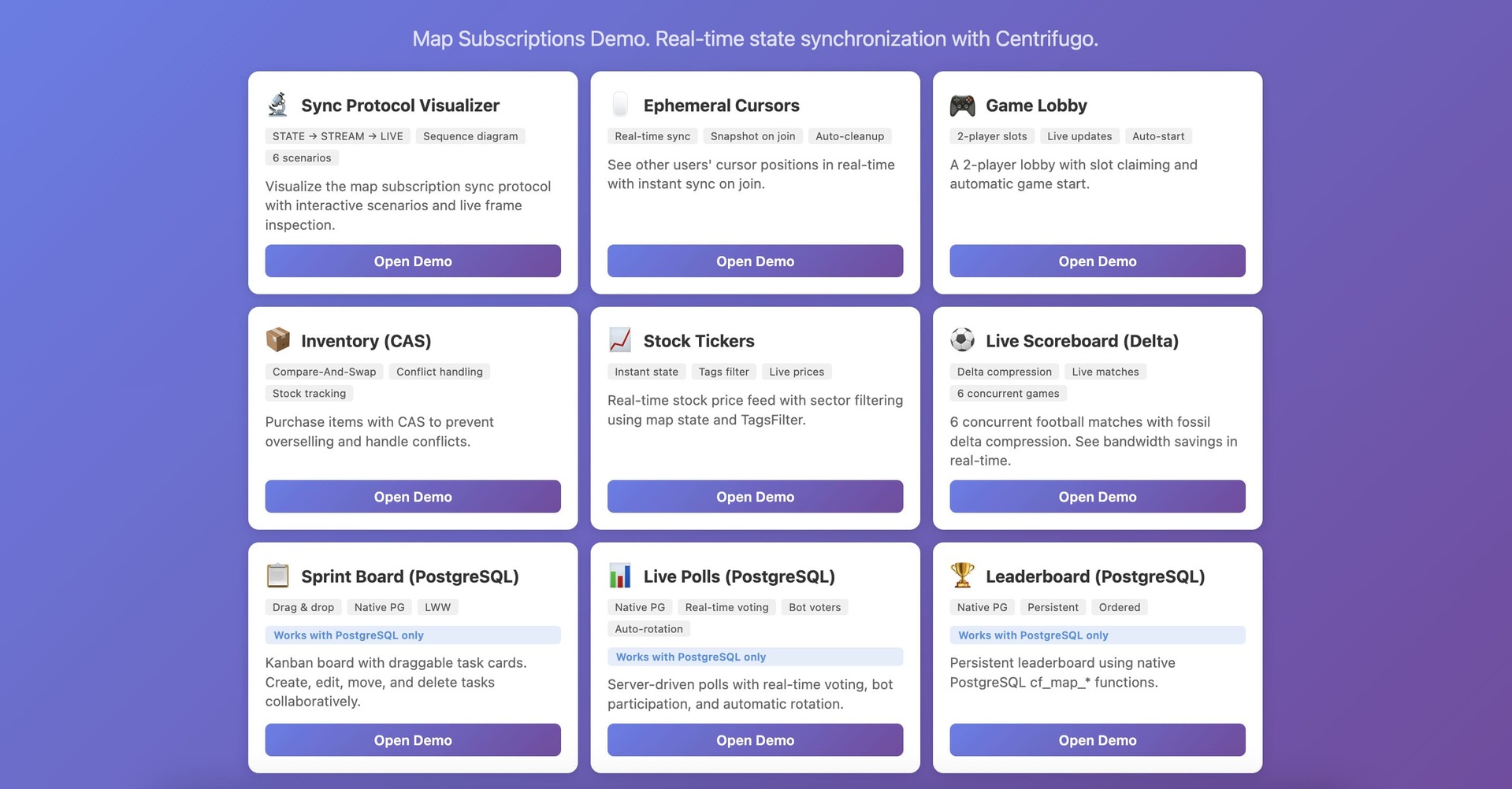
- Sync Protocol Visualizer — step through the STATE → STREAM → LIVE sync phases with interactive sequence diagrams and frame inspection
- Game Lobby — 2-player lobby with slot claiming, live updates, and automatic game start using recoverable sync
- Inventory (CAS) — compare-and-swap for safe concurrent updates with conflict handling
- Stock Tickers — real-time price feed with sector filtering using tags filter
- Live Scoreboard (Delta) — 6 concurrent football matches with fossil delta compression and live bandwidth stats
- Sprint Board (PostgreSQL) — Kanban board with drag-and-drop using native PostgreSQL
cf_map_*functions for transactional publishing - Live Polls (PostgreSQL) — server-driven polls with real-time voting, bot participants, and auto-rotation using
cf_map_*functions
The demo runs with Docker Compose (PostgreSQL + Python backend + Nginx) and requires Centrifugo v6.8.0+ with centrifuge-js.
A separate map_cursors example demonstrates real-time multi-user cursors using ephemeral sync with auto-cleanup on disconnect, backed by the Redis map broker — a better fit than PostgreSQL for high-frequency ephemeral updates.
For the app-owned state pattern (app DB as source of truth + transactional publishing via the PostgreSQL stream broker + stream subscription getState), see the pg_stream_broker kitchen orders demo and the blog post Transactional publishing for stream subscriptions with PostgreSQL.